Align Governance, Reduce Risk, and Stay Audit-Ready Across Evolving Regulations
Organizations today face a rapidly expanding and fragmented regulatory landscape spanning AI, cybersecurity, data protection, privacy, and emerging technologies. Regulations are evolving faster than most enterprises can interpret, map, and operationalize them.
Our Regulatory & Standards Alignment Advisory Services help organizations proactively align governance, controls, and evidence across global standards—so compliance becomes structured, defensible, and scalable instead of reactive and fragmented.
Organizations are facing overlapping requirements across AI, cybersecurity, privacy, risk management, and emerging technologies. Regulatory expectations are no longer theoretical, fragmented, or optional. They are active, enforceable, and increasingly aligned across jurisdictions. Failure to align early creates compliance gaps, audit friction, and operational risk that compound over time.
99.9%
Of organizations face overlapping regulatory obligations without a unified alignment strategy
Fragmented Regulations Create Hidden Risk
Identify where regulatory, security, and governance obligations intersect — and where misalignment creates exposure across AI, cybersecurity, data protection, and operational risk frameworks before issues surface during audits or enforcement.
Governance Without Alignment Slows Innovation
Establish a unified standards-aligned governance model that ensures policies, controls, and decision-making remain consistent across ISO, NIST, sector regulations, and internal risk frameworks — enabling innovation without regulatory drag.
Compliance, Trust & Long-Term Resilience
Demonstrate defensible alignment with global standards and regulatory expectations, strengthening audit readiness, stakeholder confidence, and long-term operational resilience as regulations continue to evolve.
THE PROBLEM ORGANIZATIONS FACE
Regulatory, Standards, and Compliance Risks Are Outpacing Preparedness
Organizations are operating in an environment where regulations, standards, and oversight requirements are expanding faster than internal governance can adapt. New mandates for AI, cybersecurity, privacy, risk management, and operational resilience are converging—often without clear internal ownership or coordination.
While regulatory expectations are becoming more explicit, many compliance programs remain reactive, fragmented, and audit-driven, leaving organizations exposed to enforcement actions, operational disruption, and loss of trust.
Security, legal, and risk teams are struggling with overlapping frameworks, inconsistent controls, and limited visibility—creating material risk that traditional compliance approaches were never designed to manage alone.
The result is growing exposure across:
Regulatory compliance and enforcement risk
Data protection, privacy, and information security
AI governance and accountability obligations
Third-party, supply-chain, and operational resilience requirements
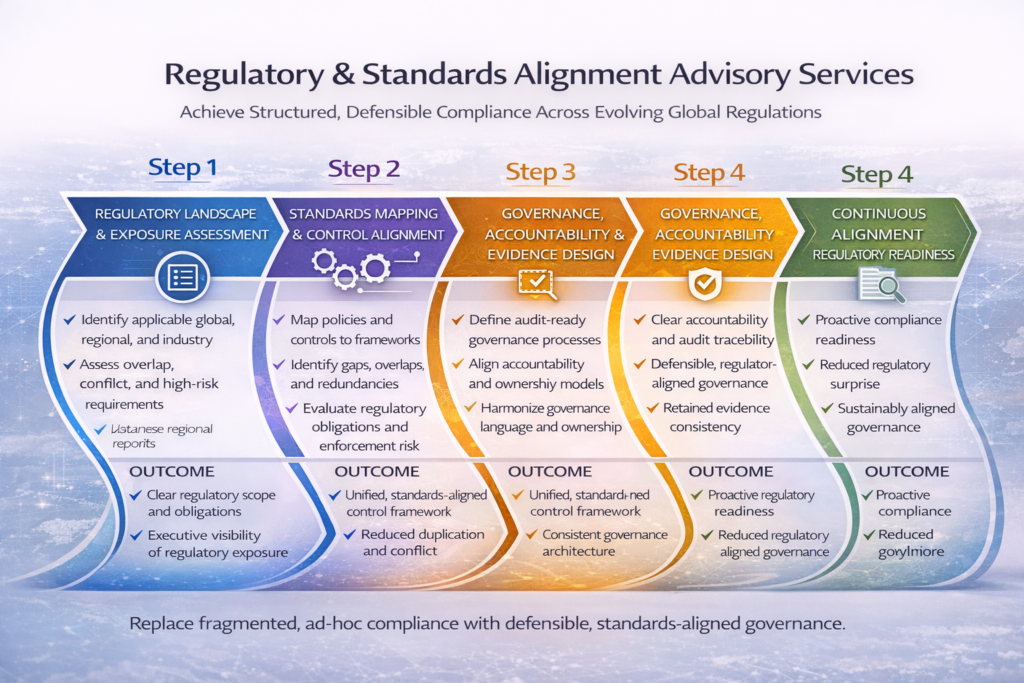
A Structured Approach to Regulatory & Standards Alignment
A practical, standards-aligned methodology to assess, govern, operationalize, and continuously improve regulatory compliance, risk management, and audit readiness—without slowing innovation or business execution.
Regulatory & Compliance Risk Baseline
Identify applicable regulations, standards, and control obligations across AI, cybersecurity, privacy, and operational risk to establish a defensible compliance baseline.
01 - Assess
Standards-Aligned Governance & Control Framework
Design a unified governance and compliance framework aligned with ISO, NIST, and regulatory expectations—ensuring accountability, consistency, and audit defensibility.
02 - Design
Operationalize Compliance Across the Enterprise
Embed regulatory and standards controls into real operational workflows—moving compliance from documentation to execution.
03 - Implement
Audit-Ready, Continuous Compliance
Continuously validate controls, maintain audit readiness, and evolve governance as regulations and standards change.
04 - Validate & Evolve
STANDARDS-ALIGNED REGULATORY APPROACH
Business Outcomes of Regulatory & Standards Alignment
Reduced Regulatory, Legal & Enforcement Risk
Proactively align policies, controls, and evidence with applicable regulations and global standards—reducing exposure to regulatory findings, enforcement actions, penalties, and reputational damage across AI, cybersecurity, and data protection obligations.
Confident, Scalable Compliance Across the Enterprise
A unified standards-aligned framework enables consistent compliance across business units, technologies, and jurisdictions—eliminating fragmented controls and enabling faster, safer adoption of AI, cloud, and emerging technologies.
Audit-Ready Transparency & Executive Assurance
Maintain clear documentation, traceable controls, and defensible governance aligned with ISO, NIST, and sector-specific standards—supporting audits, customer assurance, regulatory inquiries, and board-level oversight with confidence.
For organizations securing data where longevity, trust, and resilience matter
This advisory service is designed for organizations protecting sensitive data and critical systems that must remain secure over long time horizons—despite emerging quantum-era threats, cryptographic disruption, and evolving regulatory expectations.
Ideal for:
CISOs, CIOs, CTOs, and Risk Leaders responsible for cryptographic security, data protection, and long-term risk management
Organizations preparing for post-quantum cryptography (PQC) mandates and NIST-aligned cryptographic transition requirements
Enterprises managing long-lived sensitive data such as financial records, intellectual property, PII, healthcare data, and national or critical infrastructure information
Regulated industries including financial services, healthcare, telecom, energy, and the public sector
Cloud, SaaS, and technology providers requiring defensible cryptographic posture and future-proof security architectures
Organizations concerned about “harvest now, decrypt later” threats targeting encrypted data today for future compromise
Regulatory alignment is no longer optional—compliance expectations are accelerating and converging.